
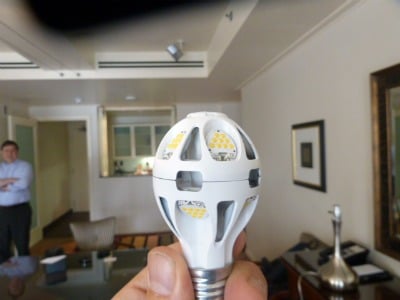
 Zeta LED has developed an air-cooled LED light bulb. The Lifebulb consumes 10 watts of power and puts out as much light as a standard 60 watt incandescent, pretty much like existing LED bulbs. The difference comes in the absence of an aluminum heat sink.
Zeta keeps its bulb cool by channeling air through the vents in the structure itself: the vents are the strips and holes separating the yellow LED arrays. The bulb does not come with a covering glass dome as air wouldn’t circulate if the electronics were completely covered. Zeta might cover the LED arrays with a piece of glass, but the vents will remain exposed.
Eliminating the heat sinks and relying on ambient airflow allows Zeta to get the bill of materials for its bulb down to close to $7 dollars, or nearly half the normal bill of materials, McClelland argued. That means Zeta’s bulbs that can retail, in mass production, for $10.
The Lifebulb comes with a new driver from Cypress Semiconductor that you soon might start seeing in other bulbs.